
How to Automate B2B Sales with AI in 2026: The Complete Guide

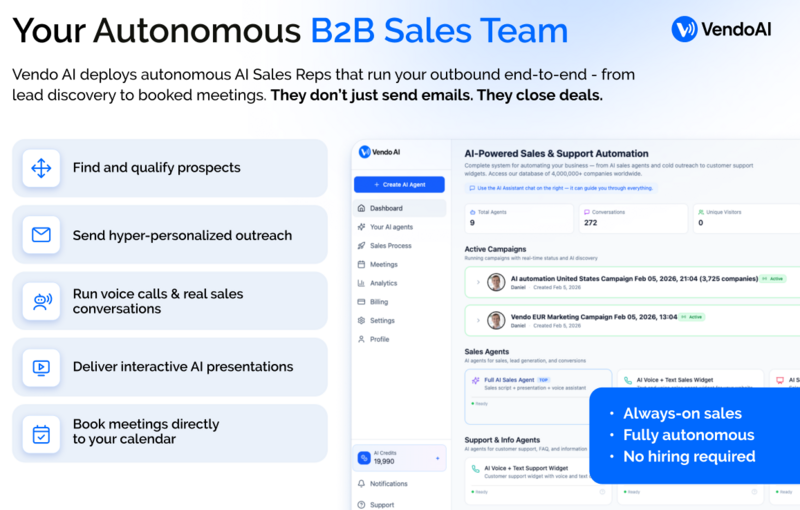
In 2024, "AI in sales" meant a writing assistant that helped your SDRs draft emails faster. In 2026, it means something structurally different: AI systems that execute the sales motion themselves — find the buyer, write the message, make the call, answer the objection, book the meeting. This guide covers what is actually automatable today, in what order to automate it, what it costs, and where teams most often get it wrong.
What can AI actually automate in B2B sales today?
As of 2026, every stage of the outbound motion up to the closing conversation can run autonomously:
- Prospecting — detecting companies with active buying intent via signals (hiring, funding, tech changes, review activity) instead of buying static lists.
- Enrichment — finding and validating the decision-maker's email, phone and LinkedIn behind each signal.
- Personalization — researching each prospect (their posts, company news, context) and writing a unique message, not a template with variables.
- Multi-channel outreach — coordinating email, LinkedIn, voice calls and messengers with intelligent timing.
- Conversations — answering replies, handling objections, qualifying and booking meetings, including by voice in 145+ languages.
- Pipeline hygiene — logging every touch and reply into a CRM automatically.
What still belongs to humans: closing complex deals, pricing negotiation, and relationships. The practical goal of automation is to make sure humans only do those things.
Step 1 — Start from buying signals, not lists
The highest-leverage change is at the top of the funnel. Blasting a static list converts poorly for a simple reason: at any moment, roughly 95% of your market is not buying. Buying signals flip the ratio by telling you who is in-market this week:
- Hiring signals — a company hiring 3 SDRs is investing in sales capacity right now.
- Funding rounds — freshly funded companies spend on growth within weeks.
- Competitor pain — negative G2 reviews of a rival product are warm invitations.
- Tech-stack changes — adopting adjacent tooling predicts readiness for yours.
- LinkedIn activity — people posting or commenting about the problem you solve.
- Job changes — a decision-maker in a new role (<90 days) has budget and mandate.
Freshness is the discipline that makes signals work: a signal older than a week is a fact, not an opportunity. (This is why Vendo SDR enforces a hard 7-day window across its 24 signal hunters.)
Step 2 — Personalize with research, not variables
"Hi {first_name}, I saw you work at {company}" is not personalization — buyers pattern-match and delete it. AI personalization in 2026 means the system reads the prospect's recent LinkedIn activity, company news and the signal that surfaced them, then writes a message that opens with why you are reaching out now:
"Saw you're scaling the SDR team — three open roles this week. Most teams hit a ramp-up wall around month two…"
Messages built this way are unique per prospect — zero duplicates across a campaign — and it shows in the numbers: signal-based, AI-researched email consistently runs at roughly 2× the industry open rate (39% vs ~21% in our own campaign data).
Step 3 — Go multi-channel, in the right order
Single-channel automation hits a ceiling because your buyers answer in different places. The channels complement each other:
| Channel | Best at | Typical role in the sequence |
|---|---|---|
| Detail, links, async decision-makers | First touch + follow-ups | |
| Warm context, social proof | Parallel touch; reacts to activity signals | |
| AI voice call | Urgency, qualification, booking on the spot | Escalation when messages go unanswered |
| WhatsApp / Telegram | Fast replies in mobile-first markets | Regional follow-up channel |
| Website widget / AI presentation | Inbound capture, product storytelling | Always-on conversion layer |
The orchestration matters more than any single channel: the system should escalate automatically — email ignored → LinkedIn touch → voice call — with timing decided per prospect, not per cohort.
Step 4 — Let the AI answer replies
Most "automation" stops at the first reply, dumping everything into a shared inbox where response times stretch to hours. That is where deals die: reply-to-meeting conversion decays fast with latency. Modern autonomous agents answer within seconds, in the prospect's language, handle the standard objections ("send me a deck", "what does it cost", "we already use X"), and drive to a booked meeting — flagging a human only when the conversation is genuinely qualified.
Step 5 — Close the loop: CRM and learning
Two things separate a system from a set of scripts:
- Automatic pipeline capture. Every reply should become a lead card with its originating signal and the full conversation attached — no copy-pasting, no "forgot to log it".
- Outcome-based learning. The system should measure which signal types actually convert to meetings and shift budget toward them automatically. Signals that book meetings get boosted; signals that only generate volume get demoted.
Which tools do what
The market splits into four categories that are easy to confuse: autonomous AI sales systems (the AI executes), sales-engagement platforms (human reps execute faster), channel specialists (one channel, maximum depth), and data/enrichment layers (they prepare outreach but don't run it). We maintain an honest, regularly updated breakdown of all four — including where our own product does and doesn't fit — in our Best AI Sales Automation Tools 2026 guide, with detailed pages for Apollo, Instantly, Outreach and Gojiberry.
What does it actually cost?
The honest comparison is not tool vs tool — it is automation vs headcount. A single SDR costs $60–90K/year fully loaded, ramps for 3 months, and works 40 hours a week in one language. An autonomous system runs 24/7 in every language for a subscription: on Vendo AI's pricing, $99/month buys 15,000 credits — roughly 15,000 personalized emails, or ~1,000 minutes of AI voice calls, or any mix. Even at the enterprise tier ($1,200/month), the math is a fraction of one hire.
The five most common mistakes
- Automating volume instead of relevance. Sending 10× more bad email gets your domain burned. Fix targeting (signals) before scaling sending.
- Templates with variables. If your "personalization" is {first_name} and {company}, buyers see through it — and so do spam filters.
- Stopping at the first reply. If a human has to notice and answer every response, you automated the cheap half of the job.
- Single-channel dependence. Deliverability wobbles, LinkedIn caps invitations (~70–80/day per account, server-side). Diversify before you are forced to.
- No feedback loop. If the system doesn't know which touches became meetings, it optimizes for activity, not revenue.
Frequently asked questions
Can AI really replace SDRs in 2026?
It replaces the repetitive SDR motion — prospecting, first touches, follow-ups, qualification, booking. It does not replace closers or relationship-building. Most teams run AI for volume and humans for judgment, shifting the ratio as results come in.
Is AI-automated outreach legal and compliant?
Yes, when it follows the same rules as human outreach: CAN-SPAM, GDPR and PECR compliance, working unsubscribe mechanisms, honest sender identity, and suppression lists. Reputable platforms build these in; the compliance burden doesn't disappear, it gets systematized.
How long until AI sales automation shows results?
Signal-based systems typically show first replies within days and a meaningful meeting pipeline within 2–4 weeks — one honest test cycle. Judge on booked meetings and reply quality, not lead counts.
What's the difference between an AI SDR and sales engagement software?
Sales engagement software (Outreach, Salesloft, Apollo) organizes work for human reps — they still write, call and reply. An AI SDR or autonomous sales system executes those steps itself and hands humans only qualified conversations.
See autonomous sales on your own pipeline
Point Vendo AI at your website — 24 signal hunters start finding in-market buyers and the AI handles outreach across 6 channels. From $99/month.
Start Free Trial